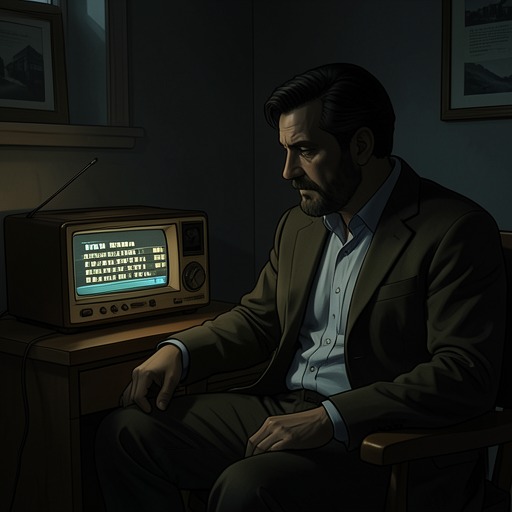
“There aren’t any baddies among those who don’t listen to news”
The Box Man“There aren’t any baddies among those who don’t listen to news” is a maxim through which the box-man narrator defends his refusal to accept the news. It makes that refusal sound like a moral distinction, but a later exchange turns the claim back on him: rejecting change, the text suggests, may also mean trying to stop time.
The Claim and Its Logic
The narrator states that “there aren’t any baddies among those who don’t listen to news” while resisting the Doctor’s words. He connects disbelief in news to disbelief in change, presenting his stance not as an attempt to alter the world but as a refusal to accept its changing account of itself. The maxim thus offers a kind of shelter: people outside the news need not be sorted into the categories it supplies.
That shelter is unstable even in the narrator’s own explanation. He says he has no intention of changing things arbitrarily, yet the claim rests on not believing in change. The distinction between declining to intervene and denying change is left unresolved, making the expression both a self-justification and a clue to the narrator’s unease.
A Challenge to Stasis
The fake box man later repeats the idea in altered form, asking whether there is “no villain among those who hate news.” He then calls the narrator inconsistent: the narrator fears receiving what he asked for and is, in effect, stopping time. The challenge shifts the maxim from a moral judgment about news-avoiders into an accusation about the narrator’s conduct. His refusal is no longer simply a way to remain outside public narratives; it may also be an effort to prevent an anticipated change from arriving.
The exchange does not settle whether the narrator’s position is sincere or merely protective. Instead, the difference between not believing the news and not believing in change becomes the point of pressure. The phrase’s confident moral simplicity is set against the more complicated behavior it is meant to explain.
News and Documentary Records
The surrounding narrative places this dispute beside news-like documents that make people visible through official descriptions. One report recounts the arrest of 180 people in and around Ueno during a police sweep; most were released after agreeing not to return to vagrancy, and the report says that almost all appeared to have returned to their former haunts within an hour. Another records the discovery of an unidentified man who had remained unnoticed in a busy Shinjuku Station passage for hours. These accounts do not directly explain the narrator’s maxim, but they show the kinds of public record against which his refusal to listen takes shape: news can classify people, while its reporting can also reveal how easily they go unseen.
Recurrence and Significance
The expression’s later reappearance matters because it is not merely repeated; it is turned into a test of the narrator’s position. Its first use makes indifference to news seem compatible with innocence. The reply exposes the cost of that indifference when it becomes resistance to change itself. In this way, the maxim condenses a central tension in the passage: the wish to remain beyond public accounts may preserve a sense of freedom, yet it can also become an attempt to hold experience in suspension.